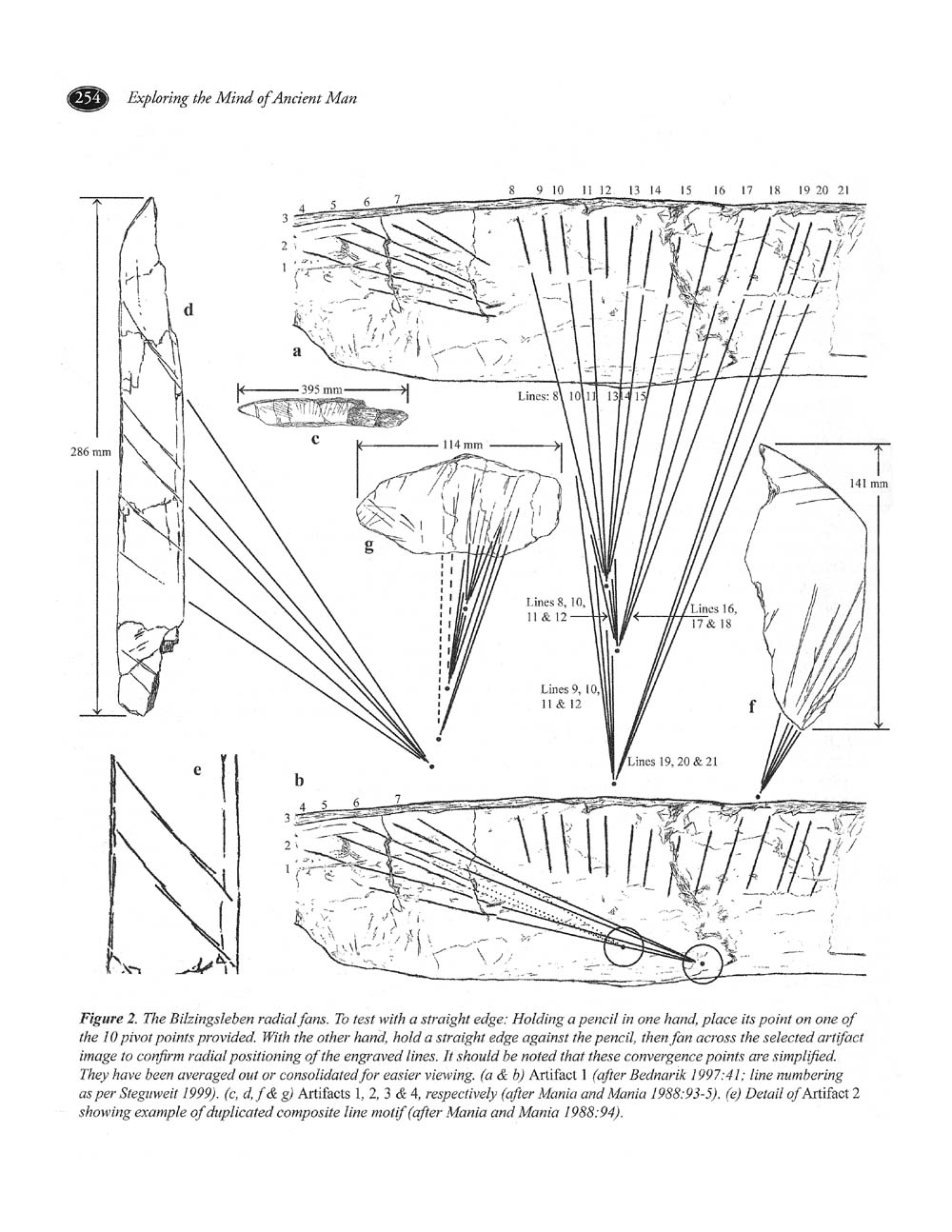
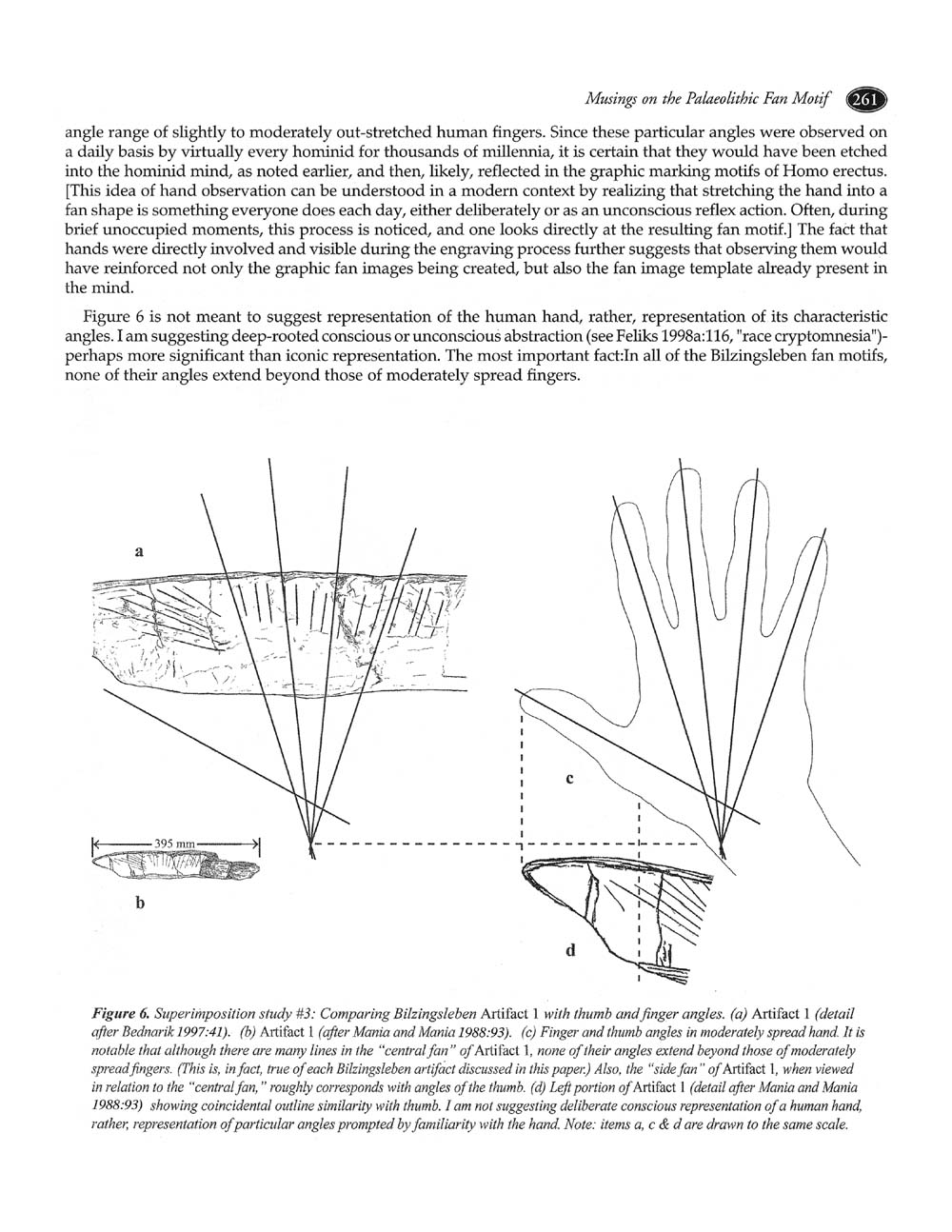
The figures for Straight edge theory were
deliberately set up so that the reader could instantly test the
radial lines for themselves right on the printed page,
thus bypassing
the need to be either
convinced or unconvinced by any scholarly argument or argument from
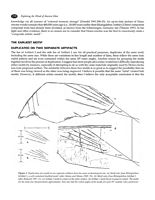
authority. Prior to these studies, all writers in anthropology -
without exception - have referred to the lines on Bilzingsleben
Artifact 2 (far left artifact in
Fig. 2), for
instance, as "parallel" lines. The straight edge test shows that
the lines are, in fact, "radial," referenced to a point well away
from the artifact itself.
The straight edge engravings from Bilzingsleben are
securely dated
320,000-412,000 years old
and show that just because an engraved line
is ancient we can no longer simply assume that it was necessarily done
freehand.
Resistance to straight edge theory, especially in this year
of Darwin, is due in large part to the fact that use of a straight edge
is proof of unambiguously sophisticated behavior. In and of itself, and without
need of any other evidence except its already-established association
with the remains of
Homo erectus, use of a straight edge demonstrates
completely modern intelligence 400,000 years ago.
In other words, straight edge theory demonstrates that there has been no change whatsoever in human
cognitive ability for at least 400,000 years.
The final proofs of
straight edge use by
Homo erectus were presented at the
XVth UISPP Congress in Lisbon, September 7, 2006 during the
Pleistocene Palaeoart of the World session in a program called
The Graphics of Bilzingsleben.
Censorship of these uncontested final proofs began within one week of the Congress.
The data, which has been studied by scientists in every field
(archaeology, psychology, neuroscience, linguistics), as well as by
engineers in Europe, the United States, and Australia, has been held
back from the public for two and a half years while those who have had
privileged access to the data have been quickly altering their
publication course both online and in print without citing
Musings on the Palaeolithic fan motif or its follow-up,
The Graphics of Bilzingsleben.
|
How straight edge use by Homo erectus proves early language and representation:
Any
line engraved with the aid of a straight edge is directly symbolic of
the straight edge itself, being a "representation" of the edge.
Additional support is offered by the two duplicated motifs discussed below. While apparently
referring to each other visually, they each also refer to the exact
same "external" object or concept, namely, the straight edge.
|
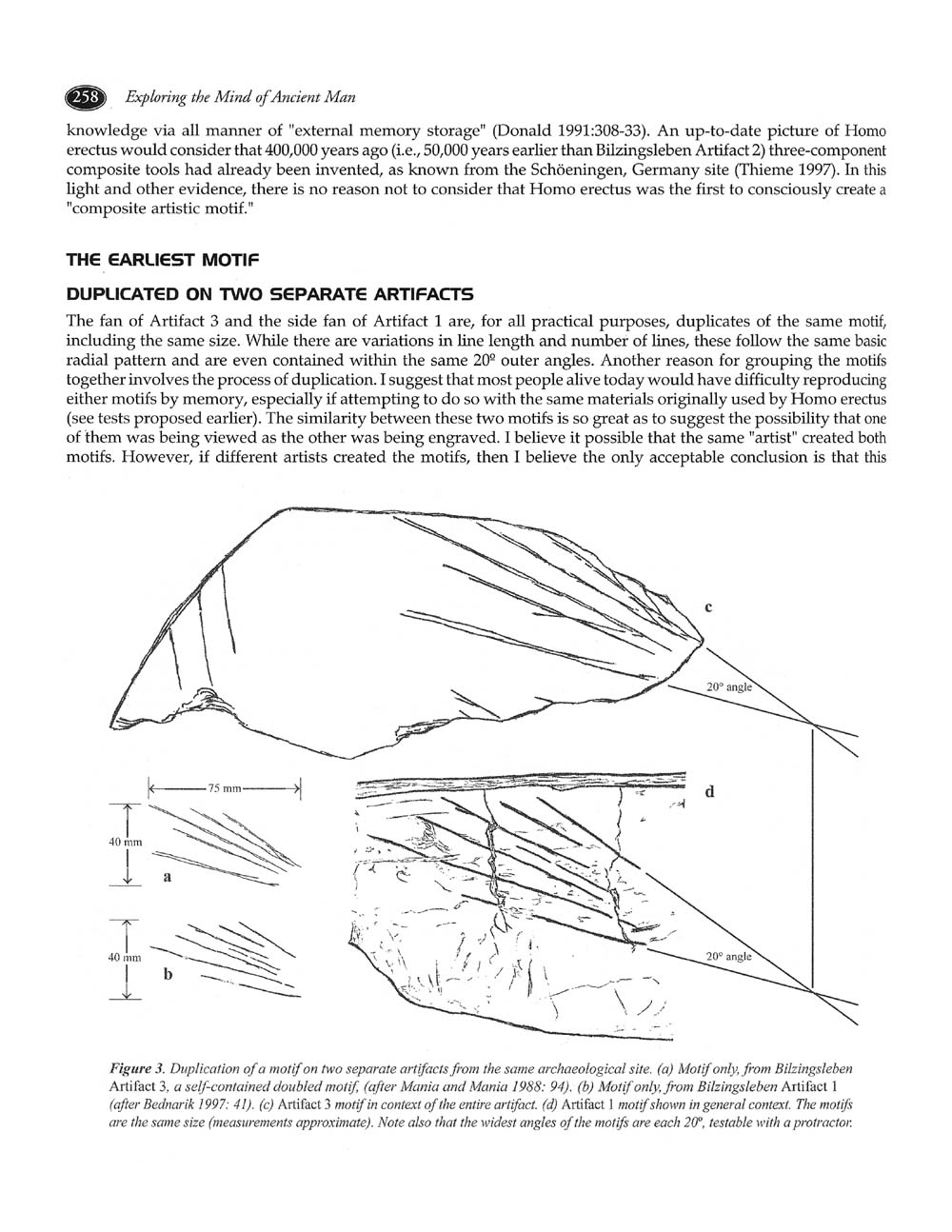
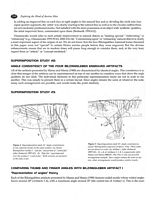
2.) 'The earliest motif duplicated on two separate artifacts.' These two duplicated radial motifs represent the first unambiguous geometric and linguistic proof of
early
language (
Fig. 3, left). Duplicated
motifs such as written or spoken words or even agreed-upon symbols are the hallmark of language.
Prior to recognizing these two motifs as either duplicates or
variations of each
other, most proponents of early language used
unrelated references to "infer" language in early peoples. For example, "If
they could get from
here to there then they must have had language," or "If they had the
right vocal tract or the right genetic traits, they probably had a
simple language."
The
geometric association between these two motifs and similar associations between
other motifs at Bilzingsleben were fully
demonstrated with final and unambiguous visual proofs at the XVth UISPP Congress in the program,
The Graphics of
Bilzingsleben, the dat of which has been held back from publication since 2006.
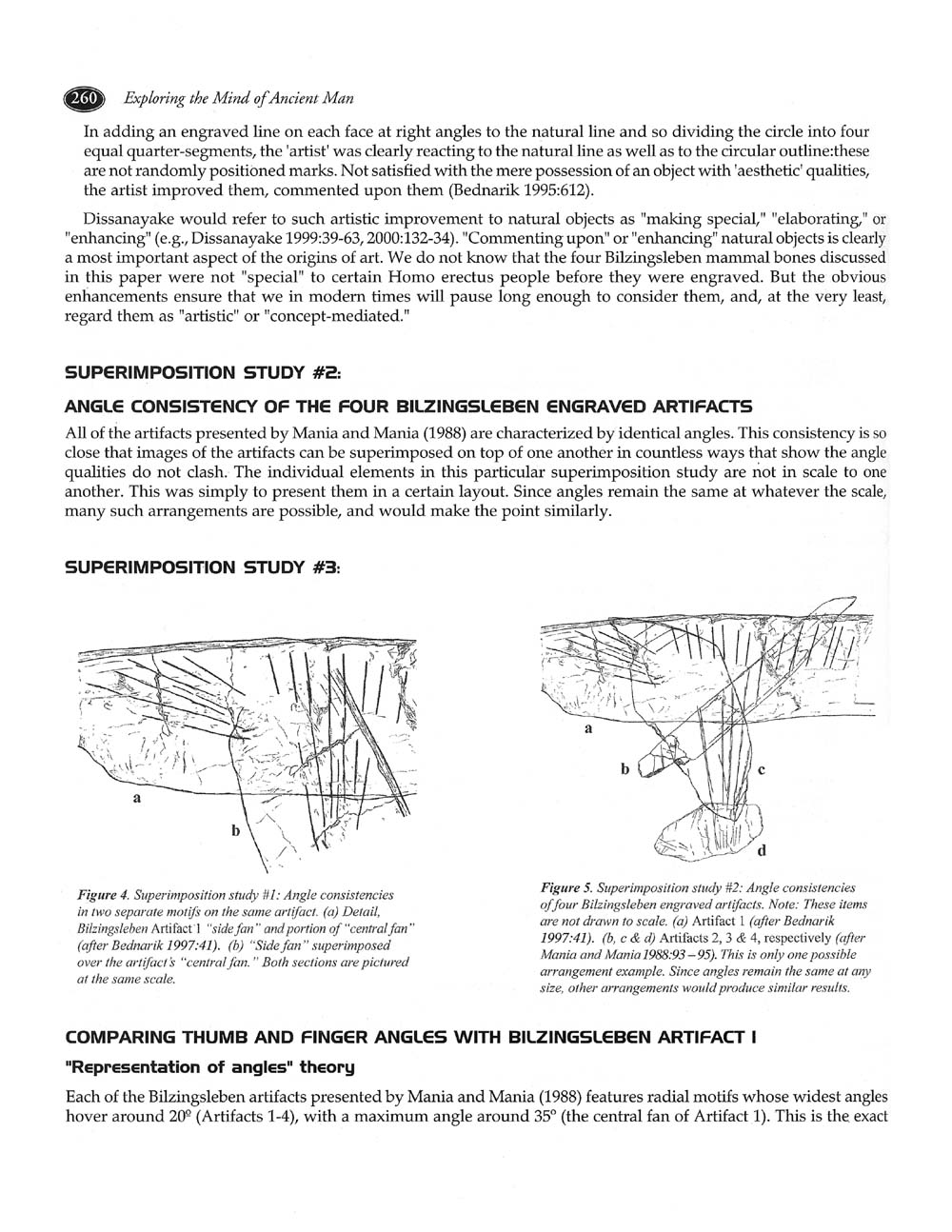
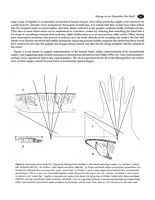
3.) 'Representation of angles theory.' Angles represented in the bone engravings from Bilzingsleben are shown
to revolve around those
angles which, beyond any doubt, are most commonly observed by human beings both
past and present, namely, those of
the outstretched human hand (
Fig. 6, right). The point is
made that the engravings do not necessarily represent the human hand
per se but rather an awareness of
the abstract concept of angles inspired by constant exposure to the human hand. It is suggested that signs of
abstraction in the archaeological
record (such as an awareness of angles) may say more about the intellectual capabilities of early people
than the more quickly-recognized forms of
iconic representation or images that clearly represent other things by way of a visual likeness.
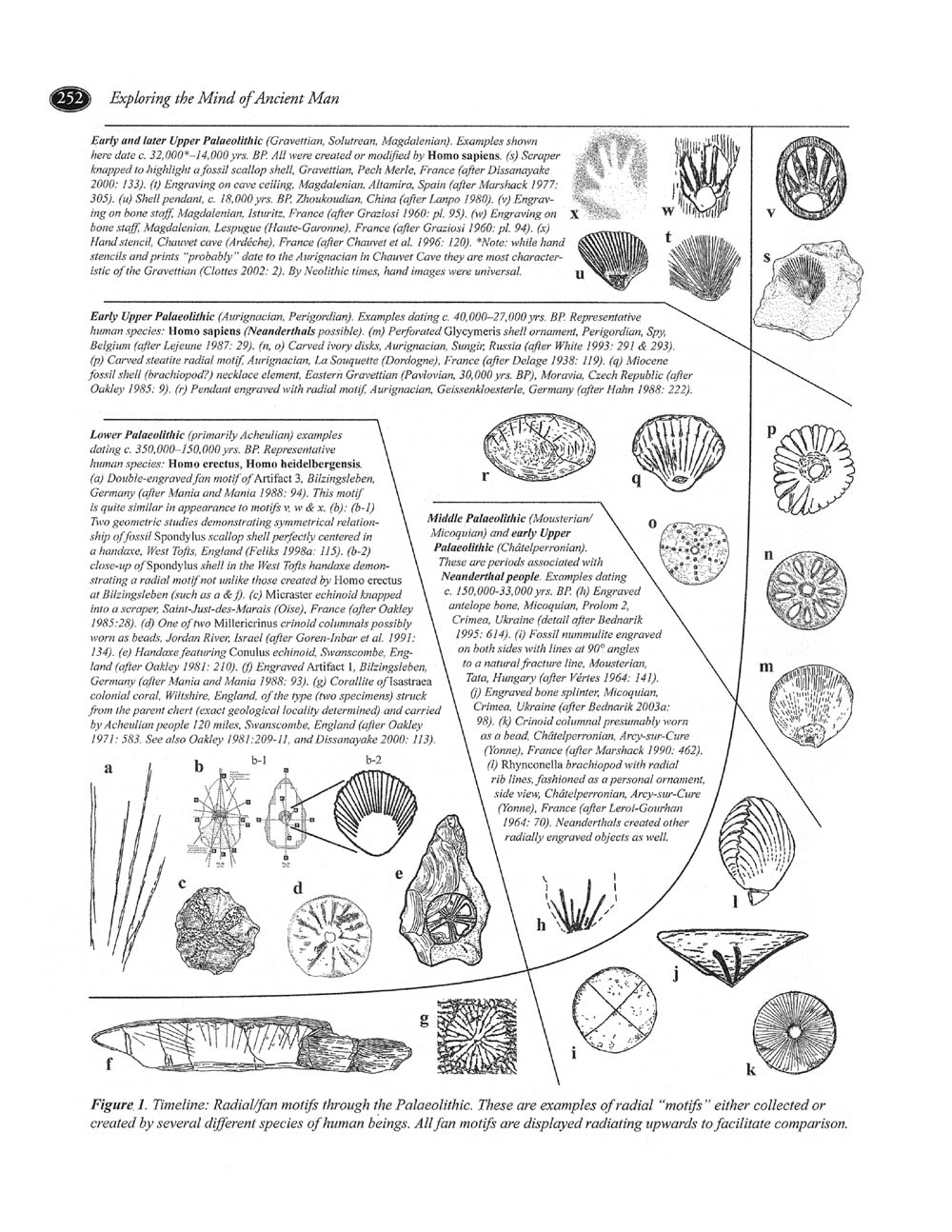
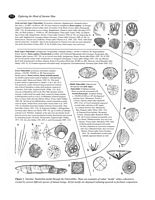
In the paper's
Fig. 1,
it was demonstrated by way of abundant physical evidence from the
archaeological record that one of the first patterns to greatly
interest early humans was the radial motif, otherwise known as the fan
motif. The radial motif was not only
engraved on bone and rock by early humans and
painted on cave walls and ceilings but also
collected ready-made in the form of fossils and shells. See also,
The Impact of Fossils on the Development of Visual Representation.